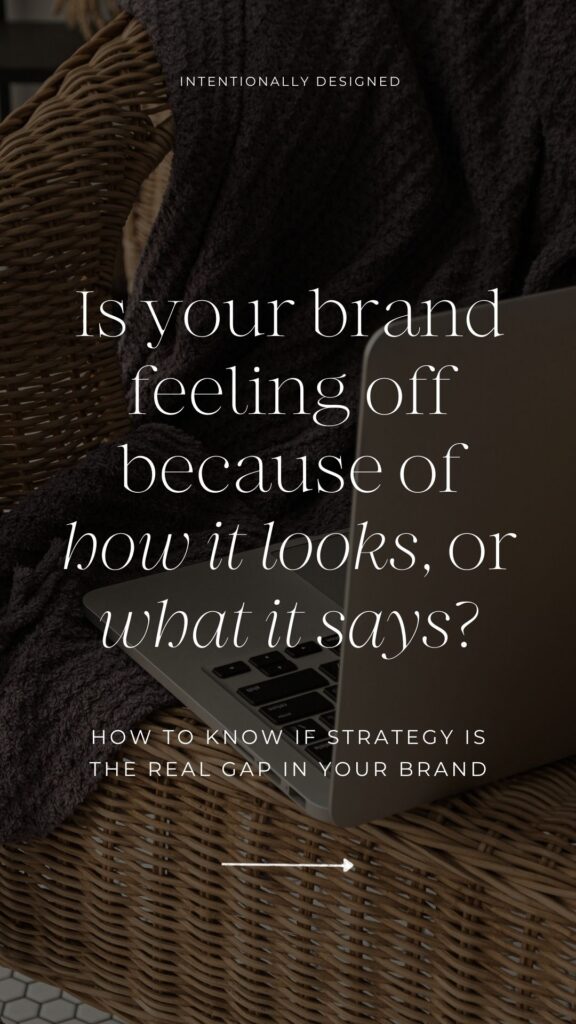
There is a particular kind of hope that lives in a rebrand.
A new logo. A palette that finally feels cohesive. A website that looks the way your work actually feels. And I want to say clearly: that hope is not misplaced. Beautiful, intentional design does something real. It signals that you take your work seriously. It creates trust before a single word is read. It makes showing up online feel like something you’re proud of rather than something you’re quietly embarrassed by.
But after years of working in brand strategy for Christian women, I’ve watched enough rebrands unfold to know something that doesn’t get said enough: design cannot create clarity. It can only amplify what’s already there.
Which means if the message underneath is muddy, a new visual identity just makes the mud look more polished.
The noise problem that design alone can’t solve
Online business is loud. I don’t mean that in the vague, inspirational way people say it before they tell you to “just be authentic.” I mean there is a genuinely staggering amount of content, competition, and distraction sitting between your brand and the person you’re trying to reach, and it is not going to get quieter.
The brands that cut through that noise are not always the prettiest or the most active. They’re the ones that are clear — about who they serve, what they actually offer, and why it matters. That clarity does the work that no color palette can do.
This is especially true for small, online-based businesses. When you’re a solo or small team without a marketing budget, visibility and word of mouth do a lot of the heavy lifting, and both depend on your message being specific enough that people know exactly who to refer you to and why. A beautiful brand that says something vague to everyone will consistently out-lose a simpler brand that says something precise to the right people.
Design amplifies your message. So the question worth sitting with is: what exactly is it amplifying?
What brand strategy actually is (and why it’s not optional)
Brand strategy gets a reputation for being the unsexy part — the thing you have to slog through before you get to the fun design work. I understand why it feels that way. Strategy lives in documents and frameworks and sometimes uncomfortably honest conversations about who you actually serve versus who you wish you served.
But brand strategy is not a formality. It is the foundation that every other decision rests on.
When your strategy is clear, you know exactly what your brand needs to communicate and who it needs to speak to. Your designer has something real to work from rather than guessing at your aesthetic preferences. Your copywriter can write to a specific person instead of a vague “ideal client.” Your website has a job to do and knows how to do it. And you — the person building all of this — stop second-guessing every caption, every offer description, every inquiry response, because the foundation is solid enough to hold the weight of those decisions.
For Christian women building faith-rooted businesses, strategy carries an added dimension. Your brand isn’t just a marketing mechanism — it’s a reflection of your calling, your values, and the specific work God has put in front of you. That’s not something you want to build on a surface that was never strategically thought through. The message at the center of your brand matters, and it deserves to be clarified with intention before it gets dressed up in beautiful visuals.
What happens when we skip it
I’ve seen this pattern more times than I can count. A client invests in a beautiful new visual identity — genuinely lovely work — and six months later she’s back, feeling the same friction she felt before the rebrand. The fonts are better. The logo is more cohesive. But something still feels off, and she can’t quite name it.
Because the thing that felt off was never the fonts.
It was the foundation. She didn’t know clearly enough who she was speaking to. Her messaging was trying to appeal to too many people and landing with too few. Her offers weren’t positioned in a way that made the decision easy for the right client. And no amount of good design was going to fix that, because design doesn’t make decisions — it reflects them.
This is not a criticism of the designers involved. Good designers can only work with what they’re given. If the brief is vague, the strategy is thin, or the messaging hasn’t been worked through yet, even the most talented designer in the world cannot compensate for what isn’t there. The design will look nice and the brand will still feel off, because the problem was upstream.
Skipping strategy doesn’t save you time. It borrows it from your future self, who will eventually have to do the work anyway — usually after spending money on design that couldn’t fully deliver without it.
How to know if strategy is the real gap
If your brand feels off right now, it’s worth asking yourself which kind of off it actually is before you reach for a design solution.
Does the visual identity feel dated or inconsistent? That’s a design problem, and design can solve it.
But if your website gets visitors and very few of them inquire, that’s probably not a design problem. If you’re attracting clients who aren’t quite the right fit, that’s a messaging and positioning problem. If you feel like you’re constantly explaining what you do and people still don’t quite get it, that’s a clarity problem. If your content feels scattered or your brand feels like it belongs to a version of you from two years ago, that’s a strategy problem.
Design cannot fix those things. Strategy can — and once the strategy is clear, design becomes significantly more powerful because it has something precise to amplify.
A few honest questions worth sitting with:
- Can you describe your ideal client in specific, concrete terms — not just demographics, but what she’s feeling, what she’s struggling with, and what she’s actually looking for?
- Do you know exactly what makes your approach different from others doing similar work?
- Is your messaging saying one clear, specific thing, or is it trying to say several things at once and landing softly on all of them?
- When someone lands on your website for the first time, do they immediately understand who you serve and what you can do for them?
If any of those felt uncomfortable, that’s useful information. It doesn’t mean something is wrong with you or your business. It means the strategy work is still ahead of you, and doing it before the next design investment will make that investment actually land.
The order of operations that changes everything
Brand strategy first. Visual identity second. Website third. Content that flows from all of it.
That order is not arbitrary. Each layer depends on the one before it. Your visual identity should be a direct expression of your strategy — the mood, the positioning, the audience, the message all translated into color and type and image. Your website should be built around your strategy — the structure, the copy, the flow all working together to move the right person toward the right next step. Your content should reinforce your strategy consistently, so that every post and every email is quietly doing the work of building trust with the specific person you’re trying to reach.
When that order is honored, everything becomes more coherent and more efficient. You’re not redesigning every few months because something still doesn’t feel right. You’re not rewriting your about page for the fourth time because you’re still not sure how to describe what you do. You’re not creating content that feels disconnected from your services or your offers.
You’re building something with a foundation strong enough to hold what you’re putting on top of it.
That’s what good brand strategy does. Not because it’s a trendy process or a box to check, but because clarity — real, specific, honest clarity — is what makes everything else work. And for those of us building businesses that are also, in some way, ministries, getting that clarity right is about more than conversion rates. It’s about stewardship. It’s about making sure the message God has given us is going out into the world clearly enough to actually reach the people it’s meant for.
A word before you invest in anything
If you’re at the point where you know something needs to shift in your brand, I want to encourage you to resist the instinct to reach first for the most visible solution. A new logo is visible. A website redesign is visible. Strategy is less visible, but it is the reason the visible things work.
Start with the foundation. Get honest about your message, your positioning, and your audience. Then let the design reflect that work. In that order, every investment you make will carry further and last longer.
If you’re not sure where your brand actually stands, I’d start with why your website won’t work without branding — it goes deeper into how strategy and design have to work together to actually convert. And if you want outside eyes on your specific brand before you decide on next steps, the Brand Alignment Audit is a free way to get a clear, honest read on what’s working and what isn’t.
The design can come. Clarity has to come first.
More resources
- Why your website won’t work without branding
- Why you should work on your branding first
- 4 things your brand might be doing to quietly turn away your ideal clients
Save for later
Enjoy this post and want to come back to it? Pin the image below to your branding board on Pinterest so you’ll always have it on hand.